What it brings when seven technology centers work as a network: critical mass, shared infrastructure and a single voice. The case of the GUARDIANES Network.
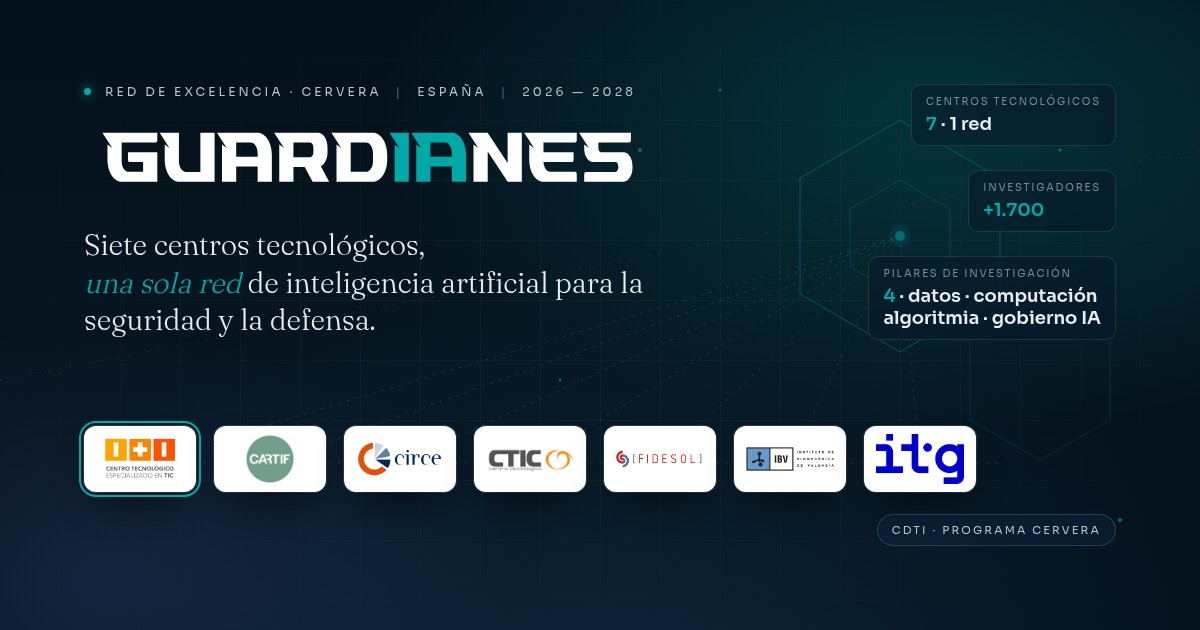
Quick answer. Working as a network lets technology centers add up critical mass, make coordinated use of each other's infrastructure, reduce the fragmentation of the technology offer and present themselves to companies and institutions with a single voice. In GUARDIANES, seven Spanish technology centers (ITI, which coordinates, CARTIF, CIRCE, CTIC, FIDESOL, IBV and ITG) combine their capabilities in artificial intelligence for security and defense.
What is a network of technology centers?
It is a grouping of technology centers that coordinate their activities, capabilities and infrastructure to contribute jointly to a common goal. Each GUARDIANES center carries out applied research and transfers technology to companies and organizations; in the network, those capabilities are pooled.
GUARDIANES is an Excellence Network funded by the Center for Technological Development and Innovation (CDTI), part of the Ministry of Science, Innovation and Universities, under the Cervera Strategic Programs. Its mission is to integrate the knowledge, capabilities and infrastructure of seven centers to accelerate the research, validation and transfer of artificial intelligence technologies applied to security and defense.
Which centers are part of GUARDIANES?
Seven technology centers spread across Spain:
| Center | Base | Who they are | Role in the network |
|---|---|---|---|
| ITI | Valencia (Paterna) | Technology center specialized in advanced digital technologies, with capabilities in artificial intelligence, analytics and cybersecurity, and focused on taking digital solutions to market | Coordinates the Network |
| CARTIF | Valladolid (Boecillo) | Applied research center with multidisciplinary capabilities in AI, robotics, security, energy, industry and technologies for critical sectors | Leads the Internationalization working group |
| CIRCE | Zaragoza | International technology center specialized in energy, sustainability and digitalization, applying AI to industry and infrastructure | Leads the Network's communication, dissemination and community engagement |
| CTIC | Gijón (Asturias) | Technology center for applied research and technology transfer, with data, AI and quantum computing solutions for companies and regions; Spanish office of the W3C (World Wide Web Consortium) | Coordinates the Excellence work package |
| FIDESOL | Granada | Technological Innovation Support Center specialized in deep technologies (advanced and quantum AI, cybersecurity and digital identity) | Coordinates the Transfer working group |
| IBV | Valencia | Technology center that develops and transfers scientific knowledge and technologies to improve people's health, well-being and quality of life | Coordinates the People working group |
| ITG | A Coruña | Center that drives business competitiveness through technology and R&D&I, with solutions based on AI, quantum computing, industrial digitalization, autonomous mobility, smart energy, digital water and sustainable construction | Coordinates the Scenarios working group |
Together, the seven centers have more than 1,700 researchers and specialized laboratories spread across the country.
What does working as a network bring? Six advantages
These advantages are the objectives the network has set for 2026–2028.
1. Critical mass and less fragmentation
GUARDIANES' first strategic objective is to strengthen collaboration and talent through knowledge sharing, more training and talent attraction. With this, the network seeks to gain critical mass and maximize impact, reducing the fragmentation of the technology offer and increasing its capacity to transfer technology and knowledge to companies.
Critical mass also has an international reading: according to the program's proposal, adding up the partners' resources gives access to international R&D networks and channels on terms that make the network attractive to candidates from other countries.
2. Capabilities that complement each other
Each center brings its own specialty. The project brings together complementary capabilities in artificial intelligence, big data, computer vision, robotics, multimodal data analysis, cybersecurity, digital twins, immersive simulation and people-centered technologies.
These capabilities are organized around GUARDIANES' four research pillars. Some examples, according to each center's profile:
| Pillar | What the centers contribute (examples) |
|---|---|
| Data | ITI works with interoperable data spaces and learning from limited information. IBV generates multimodal datasets and synthetic data, with avatars of different physical characteristics. ITG brings experience in the fusion and preprocessing of data from distributed sensors. |
| Computing | ITI researches distributed architectures and the optimization of AI models for low-resource devices. ITG develops models optimized for those devices. IBV researches how to compress body-analysis models to run them on portable or embedded equipment. |
| Algorithms and simulation | ITI leads this area, with object and scene recognition through computer vision and acoustic analysis. FIDESOL contributes immersive environments for training and simulation. ITG generates synthetic environments to train and validate systems. |
| AI governance | CTIC works on mechanisms that favor an ethical, transparent and responsible use of AI. IBV builds explainability, traceability and reliability assessment into its models. ITG integrates explainability, traceability and regulatory compliance across the whole development cycle. |
3. Shared infrastructure and less duplication
The second strategic objective is to strengthen the centers' excellence through new research and experimentation infrastructure to process and access relevant data, and to make better use, as a network, of what already exists, so that members, companies and other external players can use it.
The project plans coordinated access protocols for existing infrastructure, in order to reduce costs and widen geographic coverage. According to the program's proposal, the complementarity of that infrastructure should ensure efficient use of resources and avoid duplication. The creation of shared data spaces will also be promoted.
4. A gateway in every region
The network proposes that each center act as a “regional help desk”: a point of contact for companies, especially SMEs, to raise their needs and approach the network from their own region. The network also plans to organize technology dialogues between the centers and companies.
5. A single voice and a joint brand
The fifth strategic objective is to create and promote a joint brand that gives national and international visibility to the network and its results, and that exceeds the value of each center's brand on its own. This aims to strengthen talent attraction, market adoption of the technologies and international recognition.
6. International reach and transfer to companies
The network also wants to maximize its international impact, encouraging centers and Spanish companies to take part in international projects, networks and forums. And it wants to give technology SMEs easier access to experimentation platforms, specialized training and collaborative projects at European level.
What does collaboration look like in practice?
Two examples of how the joint work takes shape:
- A joint course. GUARDIANES' free online course brings together the knowledge of the seven centers in 4 modules, 9 topics and 21 learning pills, taught by specialists from the organizations themselves. Enrollment opens on November 2, 2026 and the course runs from November 16, 2026 to March 15, 2027. More information about the course.
- Two shared validation scenarios. The technologies of the different centers will be tested together in a tactical rescue operation in a multi-domain conflict environment and in the intelligent surveillance and control of a critical border infrastructure. The aim is to integrate the technologies developed in GUARDIANES and check how they work together.
If you want to know the project's strategic context, read the first article in this series: What is artificial intelligence for security and defense, and why does it matter to have our own capabilities?
A quick summary: frequently asked questions
What is the GUARDIANES Network?
It is a Cervera Excellence Network for R&D&I in artificial intelligence technologies applied to security and defense. It brings together seven Spanish technology centers and runs from 2026 to 2028. It is funded by CDTI and the Ministry of Science, Innovation and Universities.
Which technology centers are part of GUARDIANES?
ITI (coordinator), CARTIF, CIRCE, CTIC, FIDESOL, IBV and ITG. They are based in Valencia, Valladolid, Zaragoza, Gijón, Granada and A Coruña.
What are the advantages of centers working as a network rather than separately?
According to the network's objectives: adding up critical mass, reducing the fragmentation of the technology offer, making coordinated use of existing infrastructure and creating new infrastructure, presenting a joint brand and making it easier to transfer technology to companies and organizations.
Who coordinates the network?
ITI, the Technological Institute of Informatics, which represents the grouping and acts as the point of contact with CDTI. Each of the other centers also leads a specific area, such as communication (CIRCE), excellence (CTIC), transfer (FIDESOL) or internationalization (CARTIF).
Can companies, SMEs and other organizations take part?
Yes. GUARDIANES is open to collaboration with companies, public administrations, universities, security bodies and other organizations interested in applying AI to security and defense. One of the network's goals is to give technology SMEs easier access to experimentation platforms, training and collaborative projects. You can write to contacto@redguardianes.es.
How long does GUARDIANES last?
Three years, from January 1, 2026 to December 31, 2028.
Keep exploring
- Get to know the GUARDIANES Network
- Free AI training for security and defense
- Subscribe to the newsletter to receive the network's news.